How Much Does a Concrete Driveway Cost in Austin, and Should You Repair or Replace It?

A cracked driveway is easy to ignore until a raised edge catches a toe, water pools by the garage door, or a panel near the street tips up. Then the questions come fast. What will this cost? Can it be patched? Do I need a permit?
We build concrete driveways and sidewalks across the Austin area, and we also get called out to driveways that were poured without much thought for our clay soil and big trees. Here is how we size up a driveway, what drives the price, and how to tell a repair that makes sense from one that only delays a replacement.
How much does a concrete driveway cost in Austin?
There is no honest single number, so be wary of anyone who quotes one over the phone. Driveways are priced mostly by the square foot, then adjusted for what has to happen under and around the slab.
These items move an Austin driveway quote the most:
- Tear-out and haul-off. Breaking out the old concrete and trucking it away.
- Base work. Digging out soft clay or topsoil and replacing it with a compacted base. On rocky Hill Country lots, it can mean cutting limestone.
- Slab spec. Thickness, steel, and joint layout.
- Finish. Broom finish is the baseline. Stamped, stained, and exposed aggregate finishes add labor.
- The approach and permit. Work at the curb crosses into the City right-of-way. That adds a City permit and a contractor licensed for that work. As of October 2026, the City of Austin's fee table lists $345 for a new Driveway/Sidewalk permit, with inspection fees on top.
- Drainage. A driveway that drains toward the garage often needs regrading or a drain.
We price driveways with itemized proposals so you can compare quotes line by line. If one quote comes in far below the others, check what it leaves out. Haul-off, base work, the approach, and the permit are the usual gaps.
Should you repair or replace a cracked concrete driveway?
Don't just count the cracks. Look at whether the concrete has moved.
Repair or resurfacing usually makes sense when:
- Cracks are narrow and both sides sit level.
- The surface is flaking or worn, but the slab underneath is solid.
- One panel has a problem and the rest are sound.
Replacement usually makes sense when:
- One side of a crack sits higher than the other and creates a trip edge.
- Cracks keep growing or run across many panels.
- Water ponds on the slab or runs toward the garage.
- Edges have dropped because the base washed out.
- Tree roots have lifted whole sections.
Here is the trade-off to say out loud. A concrete overlay is a surface fix. It bonds to the slab you already have, so if that slab is still moving, the cracks will come back through. We resurface driveways that are structurally sound and tell you when one isn't. Pouring a new slab on top of the old one rarely works either, because it raises the driveway at the garage door and the street.
Replacing a few damaged panels between joints is a middle path. Just expect the patch to show, since new concrete rarely matches the color of old concrete.
Why do concrete driveways crack and shift on Austin clay?
Some cracking is normal anywhere. Concrete shrinks as it cures, so crews cut control joints to give the slab a planned place to crack. A hairline crack along a joint means the joint is doing its job.
Austin adds soil that moves. Much of the land east of I-35 sits on Blackland Prairie clay. The USDA soil series description for Houston Black clay, a classic Blackland soil whose reference site is in Travis County, says it cracks 1/2 to 4 inches wide at a foot deep during dry periods. When rain returns, it swells again. A slab on that clay rides every cycle, and it moves most where the soil gets wet unevenly.
That movement is behind many of the heaved driveways we see in places like Pflugerville, which sits on the Blackland Prairie. On Hill Country lots farther west, limestone often sits close to the surface instead, which trades clay movement for harder digging.
Downspouts that dump at the slab edge, sprinklers that soak the same edge every watering day, and beds that hold water against the concrete all make it worse. Moving that water away with drainage fixes helps a new driveway last and slows the damage on an old one. Our fall drainage and grading guide covers the yard side of that work.
What can you do when tree roots lift a driveway?
In established neighborhoods like Crestview and Allandale, big trees have had decades to grow beside driveways poured long ago. Roots spread under the slab, thicken, and lift panels. Before anyone cuts roots to pour a flat new slab, check the tree. On residential property, the City of Austin regulates trees 19 inches or more in diameter, measured 4.5 feet above the ground. The City's rules for trees on residential property call for a Tree Ordinance Review Application before you remove a regulated tree, prune 25% or more of its canopy, or do work that impacts its critical root zone. The limits are strictest near the trunk, including a cap on cut and fill in the inner half of that zone.
A driveway tear-out near a big oak can land right inside that zone. Your options usually look like this:
- Shift or narrow the driveway so new work stays farther from the trunk.
- Switch that section to pavers, which can be lifted and reset if roots move them again.
- Bring in a certified arborist to say which roots can be cut safely.
- Remove the tree if it is failing, with a permit if it is regulated. Our tree trimming and removal crew handles that part.
Settle the tree question before you sign a driveway contract. It changes the layout, the schedule, and the price.
Do you need a permit to replace a driveway in Austin?
Inside Austin city limits, it depends on where the concrete is.
- The private driveway. A driveway outside the public right-of-way is on the City's list of work exempt from building permits. Exempt work still has to meet City codes.
- The approach. The section that crosses the curb, and often the public sidewalk, sits in the right-of-way. Austin Transportation and Public Works requires a Driveway/Sidewalk permit to remove, repair, change, or install a driveway approach, sidewalk, or curb. That work has to be done by a contractor holding a City Right-of-Way contractor's license.
- Widening. Driveways count as impervious cover in Austin, and your zoning limits how much of your lot can be covered. Replacing a driveway in the same footprint doesn't change that math. Widening it or adding a parking pad does.
Outside Austin, Round Rock, Pflugerville, and Cedar Park set their own requirements, and some county or state roads need a separate permit for the connection at the street. Many HOAs also want to approve changes to driveway width, color, or finish. Ask your contractor who is pulling which permit, and get the answer in writing.
How should a new driveway be built to last in Central Texas?
Most of what makes a driveway last is hidden once it is poured. When you compare quotes, ask about:
- Base. Soft topsoil and organic material should come out, and a compacted gravel base should go in. On heavy clay, the base matters as much as the concrete.
- Thickness. Ask what slab thickness the price assumes. If you park a heavy pickup, trailer, or RV, say so up front.
- Steel. We set rebar in the driveways we pour. Reinforcement doesn't stop cracking, but it helps hold cracked pieces together and level.
- Joints. Control joints should be cut on time, with panels close to square. Long, skinny panels are more likely to crack across the middle.
- Slope. The surface should shed water away from the garage and house.
- Curing. Fresh concrete has to hold its moisture while it gains strength, which takes extra care in Austin heat.
Skimping on base work or joints to hit a low price is how a driveway ends up needing replacement years early.
Is concrete or pavers the better driveway for an Austin home?
Both work here. They fail in different ways, and that should drive the choice.
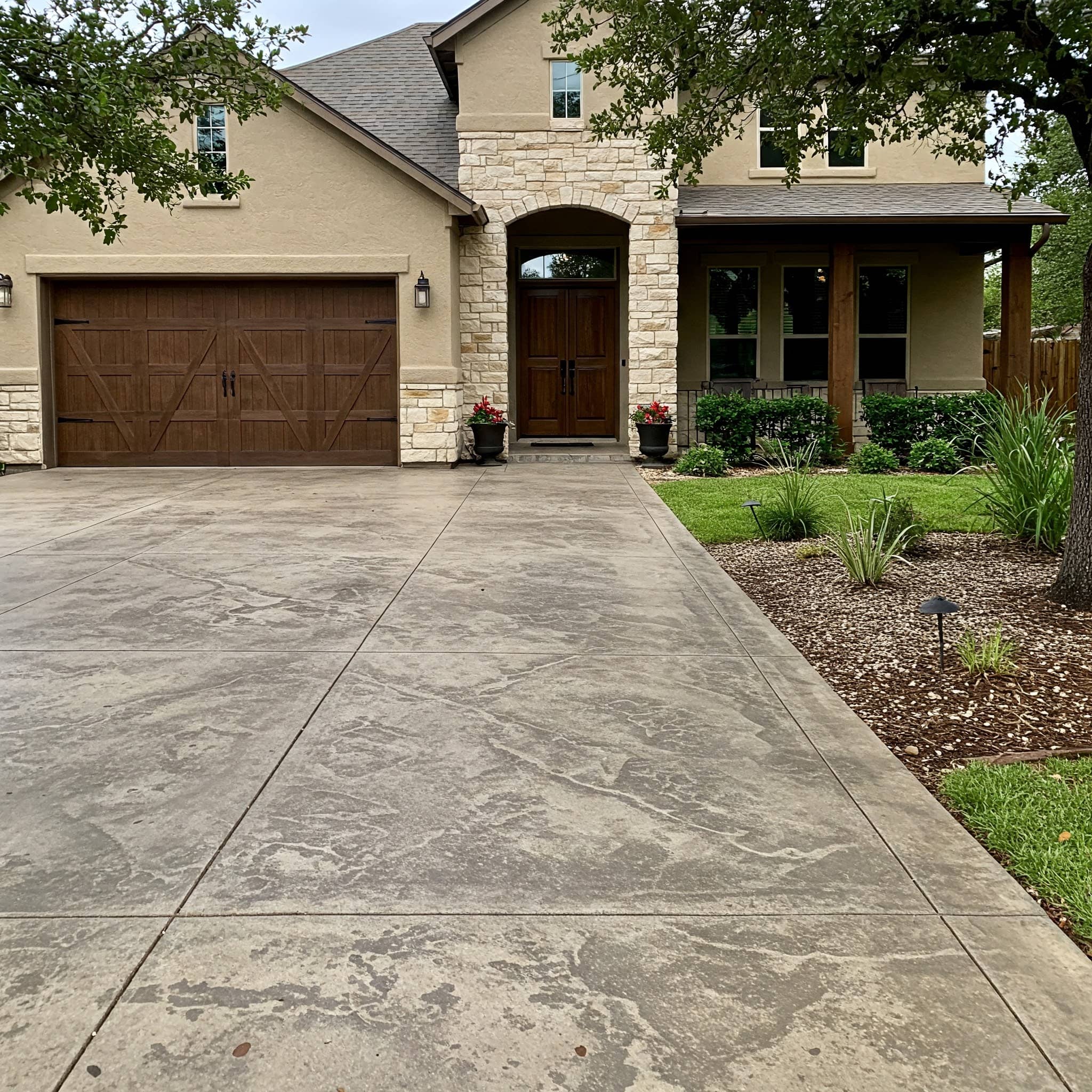
Concrete is one continuous slab. It usually costs less up front, goes in quickly, and suits most homes. Stamping, staining, or exposed aggregate can change the look without changing how the slab is built.
Pavers are individual units set on a compacted base, and they usually cost more to install. The payoff is that when roots or clay move a section, a crew can lift the pavers, fix the base, and reset the same pavers. That makes them a strong pick near big trees and on moving soil. Our paver pattern guide explains why herringbone holds up well under turning tires.
Pavers need solid edges and occasional joint sand, and a weak base will rut. Concrete needs less upkeep, but a slab repair will always show.
When should you replace a driveway, and how soon can you park on it?
Fall and spring are the easiest seasons to pour in Austin. In hot, dry, windy weather, water leaves the surface of fresh concrete faster than it can be replaced, which raises the risk of early surface cracks. That is why summer pours start early in the morning.
A replacement usually runs in this order:
- Utility locates. Texas811 asks for at least two working days' notice before digging. Utilities don't mark private lines on your side of the meter, so point out sprinkler lines and lighting wire.
- Tear-out and haul-off.
- Base repair and compaction.
- Forms and steel, plus any approach work under the City permit.
- Pour, finish, cut joints, and cure.
Plan to park on the street for a while. A common rule of thumb is to keep cars off a new driveway for about a week, and heavier trucks off longer. Get the exact date from your contractor, because the mix and the weather change it. If a permit or tree review is involved, start early.
Ready to get your Austin driveway priced?
Contact GardenGOAT with photos of the worst cracks, rough length and width measurements, and a note about any big trees nearby. Tell us if the curb or public sidewalk is damaged too, since that part needs a City permit. We will tell you plainly whether you need a repair, a resurface, or a full replacement, then give you an itemized quote for your driveway project.