How Much Does a French Drain Cost in Austin, and Do You Need One?

A hard rain is the best drainage test your yard will ever get. Water sits by the back door for two days. The side yard turns to soup. Then you start pricing a French drain, and every quote looks different.
We design and install drainage systems across the Austin area, and we also get called to fix French drains that never worked. Here is how we price the job, how to tell whether you need one at all, and what Austin's soil, rock, and rules do to the plan.
How much does a French drain cost in Austin?
There is no honest flat price, so be wary of phone quotes. A French drain is priced mostly by the foot of trench, then by what happens at each end. A short side-yard run and a full system with catch basins and a line to the street are very different jobs. Our drainage services page lists the price ranges we work in, and we price each job from a site visit.
These items move a quote the most:
- Trench length and depth. More digging, pipe, and stone.
- What the crew digs through. Wet clay is slow. Limestone may need a rock saw or breaker.
- The outlet. Letting water out in a lower part of the yard costs less than running solid pipe to a pop-up emitter or the curb.
- Inlets. Catch basins and downspout lines add parts and labor.
- Pipe, stone, and fabric. Clean, washed gravel and a good filter setup cost more now and clog less later.
- Things in the way. Sprinkler lines, utility lines, tree roots, and paving that has to be cut and patched.
- Putting the yard back. Sod, mulch, or plants over the trench.
When you compare quotes, check that each one names the outlet, the pipe type, and who repairs the sprinkler lines the trench crosses. Those are the usual gaps in a cheap quote.
Do you need a French drain, or a simpler fix?
Often you don't. A French drain is best at pulling water out of soggy soil along a line. Much of the yard flooding we see in Austin is surface water with a cheaper fix. We work through it in this order:
- Downspouts. An inch of rain on 1,000 square feet of roof is about 620 gallons. If downspouts dump it at the corners of the house, extend or pipe them first.
- Sprinklers. Spray heads that soak the same strip every watering day keep it wet. Moving heads or switching beds near the house to drip irrigation can dry it out.
- Grade. The International Residential Code calls for the ground to drop at least 6 inches in the first 10 feet away from a foundation. Beds, patios, and years of mulch can flatten that. Regrading puts the slope back.
- Swales and dry creek beds. A shaped channel can carry surface water around the house without any pipe.
- A French drain. Use one when the ground stays soggy after the steps above, or when there is no room to regrade, like a narrow side yard.
Austin Water's WaterWise Rainscape rebate pays $0.50 per square foot, with a 100-square-foot minimum and a $1,500 cap, for landscape features that capture and keep rainwater on your property. Austin Water names rain gardens, berms, terraces, and swales as examples. A French drain that pipes water off the lot is not what that program is for. Some Austin Water rebates require approval before you build, so check the current rules first.
Our fall drainage and grading guide has simple checks you can do yourself.
What is the difference between a French drain, a yard drain, and a trench drain?
Each catches water in a different place, and good systems often mix them.
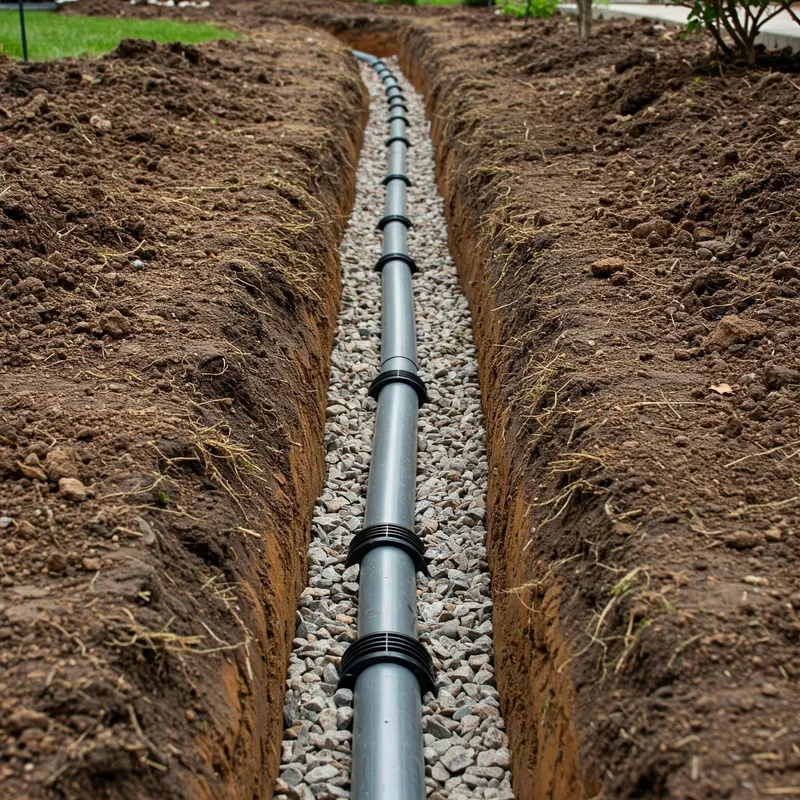
- French drain. Perforated pipe in a gravel trench. It collects water from the soil and surface along its whole length, so it fits soggy strips, fence lines, and the uphill side of a wall or slab.
- Yard drain or catch basin. A grated box at a low spot. It catches surface water at one point and sends it off through solid pipe.
- Trench drain. A long, narrow grated channel set in concrete. It catches water sheeting across a patio or driveway, often at a garage door.
A common setup is a catch basin at the low spot, a French drain along the side yard, and one solid line to the outlet.
Can you run your downspouts into a French drain?
Yes, as part of the same system, but roof water should travel in solid pipe, not in the perforated section next to the house. Perforated pipe lets water in and out along its length. Dump a downspout into it near the foundation and some of that water can push back out into the soil you are trying to dry.
When we tie downspouts into a drainage system, the roof water rides in its own solid line. That line can share the trench and join the system past the house, or run straight to the outlet.
Where can the water go once it leaves your yard?
Every French drain needs an outlet lower than where the water starts, and it is often the hardest part of the design. The usual choices:
- Daylight in a lower part of your yard, where the pipe ends and the water spreads out.
- A pop-up emitter, a small cap in the lawn that opens when water pushes up.
- The curb or street, which needs City permits, covered below.
- A dry well, a buried chamber that lets water soak in. In heavy clay, it can fill and sit full.
One outlet is off the table: your neighbor's yard. Texas Water Code Section 11.086 says no person may divert or impound the natural flow of surface water in a way that damages someone else's property by the overflow, and it lets the flooded owner recover damages. We design every outlet so your water does not become your neighbor's problem.
How do Austin's clay and limestone change a French drain?
Austin sits where the Blackland Prairie meets the Edwards Plateau, and a French drain on one looks very different from one on the other.
Clay lots
On the east side of the metro, including Pflugerville, much of the ground is Blackland clay. The USDA's Houston Black soil description calls that classic soil "very slowly permeable." Rain can't sink in, so the drain has to carry water all the way to a good outlet. Clay fines also wash into gravel fast, so the trench needs clean stone and a filter setup that keeps the fines out.
Rocky Hill Country lots
West of town, on steep lots in places like Westlake Hills, the soil is often thin over limestone. The LCRA notes the Hill Country is called Flash Flood Alley because of its steep terrain, shallow soil, and unusually high rainfall rates. Water soaks in, hits the rock, and runs along it until it pops out downhill in a patio, a bed, or the base of a wall. We often place the French drain uphill of the problem to catch that water first. Trenching through rock is slower and costs more.
A retaining wall needs drainage behind it too, which our retaining wall guide covers.
How deep should it be?
Deep enough to sit in the wet layer, and shallow enough to keep a steady fall to the outlet. On rock, the rock often decides. We check grade with a laser level as we dig so the pipe never dips.
What French drain mistakes do we get called to fix?
The ones we see most:
- No real outlet. The pipe just ends, or the outlet sits higher than the trench.
- Bellies in the pipe. Low spots hold water and silt. Flexible corrugated pipe on a soft or uneven trench bottom can sag. Rigid pipe on a firm, graded bottom holds its slope better.
- Roof water dumped into perforated pipe right next to the house.
- Clogged with clay. Dirty gravel or a missing filter lets fines fill the stone or pipe. A cleanout makes flushing possible. If the gravel itself is packed solid, that section has to be rebuilt.
- The wrong fix. A drain installed where the real problem was grade, sprinklers, or a downspout.
- Cut sprinkler lines left unrepaired, which creates a new wet spot.
How long a drain lasts comes down to clean stone, steady slope, and an outlet that stays open.
Can you install a French drain yourself?
You can, for a short, simple run with plenty of fall and an outlet in your own yard. Plan on slow digging in clay or rock, and have underground lines marked first. Texas811 asks for at least two working days' notice before you dig. It also notes that private lines generally are not marked, including sprinklers, private lighting, and lines to a pool or detached garage. Those are yours to find.
Bring in a crew when the drain runs along the foundation, the outlet goes to the curb, the trench crosses rock or big tree roots, several downspouts need to tie in, or a first attempt already failed.
Do you need a permit or HOA approval for a French drain in Austin?
Inside Austin city limits, a drain that stays on your lot is simple. Three things change that, so ask your installer which apply.
- The street, curb, or public sidewalk. That is public right-of-way. The City's right-of-way permit rules require a Driveway/Sidewalk permit for curb or gutter work and an Excavation permit for digging there, and the work needs a contractor licensed for the City's right-of-way.
- Big trees. On residential lots, the City regulates trees 19 inches or more in diameter, measured 4.5 feet above the ground. Trenching in a regulated tree's critical root zone can require a Tree Ordinance Review Application, and no impacts are allowed in the innermost quarter of that zone. Our tree trimming and removal page sums up those rules.
- Drainage easements. If your lot has a City drainage easement, permanent structures are generally not allowed in it, and you may need a license agreement to build anything there.
Outside Austin, Pflugerville, Round Rock, West Lake Hills, and other cities set their own rules. Your HOA may also want to review work that changes grading or adds anything visible from the street, like a pop-up emitter near the curb.
Ready to fix the water in your Austin yard?
Contact GardenGOAT with photos or a short video taken during or right after a rain. Show where water collects, how long it sits, and where your downspouts empty. We will find where the water is coming from, tell you plainly whether you need a French drain, a regrade, or just a downspout fix, and give you an itemized quote for the drainage work.