How Much Does a New Deck Cost in Austin, and Do You Need a Permit?

Most deck calls we get start with two questions: what will this cost, and does it need a permit? In Austin, both answers depend on more than size. How high the deck sits, whether it touches the house, what ground is under it, and how close it comes to a big oak all change the price and the paperwork.
We design and build custom decks across the Austin area, often as one part of a bigger yard plan. Here is how we think about deck cost, what the City of Austin and nearby cities ask for, and when an old deck is worth saving.
How much does a new deck cost in Austin?
There is no honest flat price, so be wary of any number given over the phone. A deck is priced on its size, its height, the boards, the railing, the stairs, and the ground it sits on.
For an outside yardstick, look at the Cost vs. Value report from JLC and Remodeling. Its 2025 edition has figures for Austin. It priced a 16-by-20-foot wood deck here at $14,807. That price includes a pressure-treated frame on concrete piers, treated deck boards, a full railing, three steps, and a built-in bench and planter. The same deck with composite boards and railing came in at $22,613. Both run below the national averages of $18,263 and $25,096.
Those are report averages, not quotes. Still, they show that a finished, mid-size deck is a five-figure project, and they give you something to measure bids against.
We price each deck after we see the yard. Our estimates are free and itemized, so you can see where the money goes and what you could change.
How much more does a composite deck cost than wood?
In those Austin numbers, the composite deck cost about 53% more than the wood one. Both decks used the same pressure-treated frame underneath, so most of that gap is the boards and railing.
The trade-off shows up later. Wood decks in our sun need cleaning and a fresh stain or sealer every few years to keep their color. Composite skips the staining, but it still needs cleaning, and darker colors get hot in July. Our wood vs. composite decking guide covers how each one looks, feels, and ages.
The report also asks real estate agents what each project adds when the house sells. For Austin, they put the wood deck's resale value at about 94% of its cost and the composite deck's at about 86%. That is an estimate, not a promise for your house.
Can you build a deck for $5,000?
Sometimes, if it is small and low. The Austin wood deck in that report works out to about $46 per square foot. At that rate, $5,000 covers roughly 100 to 110 square feet. That is a landing outside the back door, not a dining deck.
Small decks often cost more per square foot, though. Design time, delivery, permits, and stairs don't shrink much when the deck does.
If the budget is tight, a smaller deck built well beats a bigger deck built cheaply. A low, freestanding deck of 200 square feet or less may also skip the City permit in Austin. You can also design the full deck now and build part of it first.
Why does a raised deck on a sloped lot cost more?
Height adds work at every step. Taller posts need bigger footings and more bracing. Building codes generally require guardrails once a deck surface sits more than 30 inches above the ground. More height also means more stairs, and each step takes real labor.
Much of the land east of I-35, including Pflugerville, sits on Blackland Prairie clay that shrinks in drought and swells when it rains. Footings there need enough depth to stay put. In the hills west of town, limestone often sits close to the surface, so digging a footing can mean drilling rock.
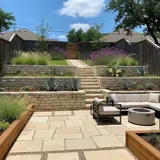
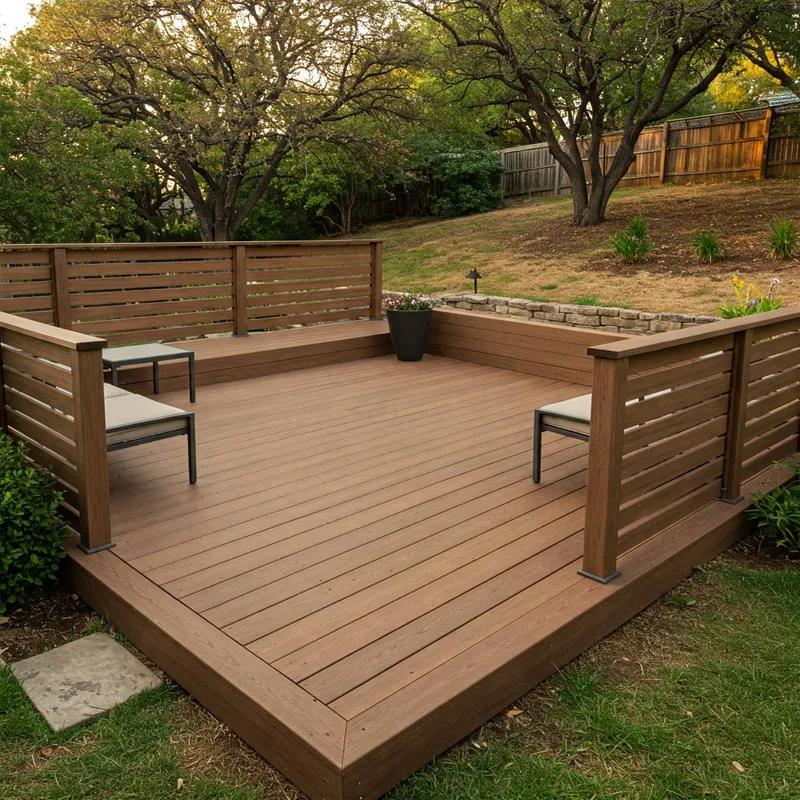
Slopes are also where a deck often beats other options. A steep yard can need a lot of fill and retaining walls before a patio will sit flat. A deck can stand on posts and reach out over the slope instead. On our Gem Court project, a steep, unusable Austin backyard became a family space with a custom deck, a flagstone patio, and a masonry bench-planter wall. If the slope also sends water toward the house, plan the grading before the deck goes in.
Do you need a permit to build a deck in Austin?
Usually, yes. On its list of work that doesn't need a permit, the City of Austin exempts a deck only when all five of these are true:
- It is 200 square feet or smaller.
- It is no more than 30 inches above grade at any point.
- It is not attached to the house.
- It does not serve as the way out of a door.
- It is not in a flood hazard area.
Miss any one and you need a permit. Exempt work still has to meet code.
Attaching the deck to the house is the biggest switch. The City's pool and uncovered deck application says an attached wood deck counts as an addition, not a small project, with a fee based on the deck's square footage. A deck that is attached, over 200 square feet, over 30 inches high, serves a door, or sits in a flood area also needs structural drawings: floor plans, elevations, framing plans, and foundation details.
Two more things to know. The application says the City's review does not cover HOA rules or deed restrictions, so HOA approval is a separate step. And skipping the permit has a cost. The City's citation schedule lists a $500 fine for a first residential work-without-permit citation, rising to $1,000 by the third. An unpermitted deck can also cause trouble when you sell.
How do impervious cover and big trees affect a deck in Austin?
Austin limits how much of a lot can be impervious cover, the hard surfaces that keep rain from soaking in. Your zoning sets the limit, and a new deck uses some of it.
Here the City gives decks a break. The deck application says uncovered wood decks with gaps between the boards, built over ground that drains, count at 50%. A 300-square-foot deck adds about 150 square feet, while a concrete patio the same size counts in full. Two cautions:
- The rule is written for uncovered decks. Covered areas count in full, so if you want a patio cover over the deck later, plan for it now.
- The form says wood decks. If you want composite, ask how the reviewer will count it before you assume the same discount.
Big trees come up on the same form. It asks whether any trees 19 inches or more across stand on or next to the property. If so, you need a tree survey and City tree review. The City's rules for trees on residential lots allow no impacts at all in the quarter of the root zone nearest the trunk, and no cut or fill over 4 inches in the inner half.
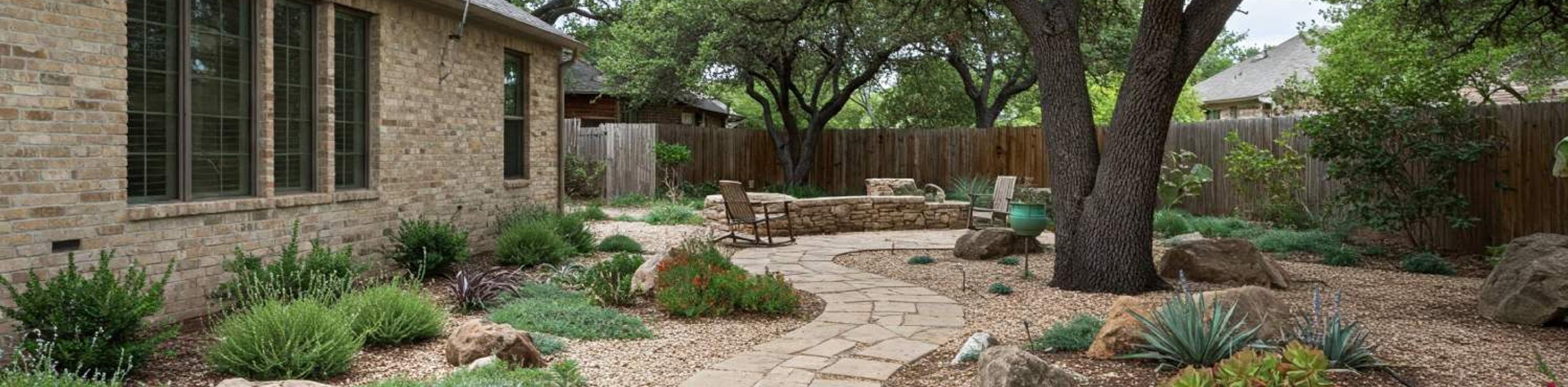
That is one reason a deck can be the better fit near a big live oak. A deck on a few piers can disturb less ground than a patio that needs a dug-out base. The tree review still decides what is allowed.
What are the deck permit rules in Round Rock and nearby cities?
Each city sets its own rules, so an Austin answer doesn't carry over. As of November 2026, Round Rock's building permits page lists these deck and patio fees:
- $125 for an uncovered wood deck without electrical or plumbing
- $200 for a covered one without electrical or plumbing
- $300 for a covered one with electrical or plumbing
Round Rock asks for a property survey showing where the deck will go and a full set of construction plans.
Pflugerville, Cedar Park, Leander, and the Hill Country cities each have their own permit steps, and many neighborhoods add HOA review. We check the rules for each address, including in Round Rock, before a design is final.
Should you repair or replace an old deck?
Start under the deck, not on top. The frame decides whether a deck is worth saving. The North American Deck and Railing Association's deck safety checklist is a good guide. These are the signs we look for:
- Soft or spongy wood in the posts, joists, or ledger board, where the deck meets the house. NADRA calls the ledger a common source of deck failure. If a screwdriver sinks in a quarter to a half inch, decay may be present.
- Rusted or loose fasteners, or a ledger held on with nails only.
- A deck that sags or sways when you walk on it or push on it.
- Loose railings, stair stringers, or treads, which matter more the higher the deck sits.
If the frame is sound, new boards and railings can give an old deck many more years, and that is usually the cheaper path. In Austin, a repair limited to the existing deck boards, without touching the guardrails or handrails, is on the City's no-permit list.
If the posts or ledger are failing, a full replacement is usually the smarter money. You get a new frame built to current code, and you can fix an awkward layout while you are at it. A rebuild goes back through the permit rules above.
Is a deck or a patio the better buy for your yard?
It depends mostly on the ground. On flat ground, a stone or paver patio often costs less per square foot than a deck and needs less upkeep than wood. Our patio cost guide breaks down patio pricing by material.
A deck makes more sense when:
- The back door sits well above the yard, so a patio would need steps down anyway.
- The yard slopes, and a patio would need fill and retaining walls.
- A big tree's roots sit where the patio base would go.
- You want to keep impervious cover low, since uncovered wood decks count at half.
Many yards use both: a deck at floor level off the house, with stairs down to a patio or fire pit area. We handle both the deck building and the masonry, so the pieces are planned together.
Ready to price a deck for your Austin home?
Contact GardenGOAT for a free, itemized deck estimate. Send a few photos of the spot, the rough size you have in mind, and whether you lean toward wood or composite. We'll tell you how your yard affects the price and which permits apply at your address.