When Should You Trim Trees in Austin? Oak Wilt and Permits

Late fall and winter are the best time of year to trim trees in Austin. The heat is gone, trees are slowing down, and oaks are inside their safe pruning window. That window closes on February 1. After that, a fresh cut on an oak can let in oak wilt, a fungal disease that has killed millions of trees across Central, North, and West Texas.
We prune and remove trees for Austin homeowners, often as the first step of a bigger project. Here is when to trim, which rules apply, what Austin Energy handles, and what drives the cost. Our tree trimming and removal page covers the services themselves.
When is the best time to trim trees in Austin?
For most shade trees, late fall through winter. The International Society of Arboriculture (ISA) says growth and wound closure are best when pruning happens before the spring growth flush. It also warns against heavy pruning right after that flush, when the tree has just spent its energy on new leaves.
Here is how that plays out in Austin:
- Oaks: Prune from July through January. The coldest weeks, November through early January, are the safest.
- Other shade trees, like cedar elms and pecans: Late winter, before spring growth, works well.
- Dead, broken, or hanging limbs: Any time. ISA says light pruning of dead or weak limbs can happen in any season with little effect on the tree. On an oak, paint the cut.
So which months should you not trim? In Austin, February through June for oaks, and spring for heavy pruning on most other trees.
Why can't you prune oaks from February through June?
The short answer is oak wilt. The Texas A&M Forest Service asks Texans to avoid pruning or wounding oaks from February through June.
Red oaks are the most at risk. An infected red oak can die in as little as a month, and a dead one can grow spore mats under its bark. The mats draw small, sap-feeding beetles that can carry spores to a fresh wound on any oak. Spring brings the most mats and the most beetles, so an April cut is far riskier than a December one.
Live oaks add a second problem. The Forest Service says they can pass the disease to each other through connected roots, so one sick tree puts its neighbors at risk.
Paint every oak cut
The Forest Service says to paint oak wounds no matter the time of year. The City of Austin says any type of paint works, because it hides the smell of the fresh cut from the beetles. On most other trees, we leave cuts unpainted. ISA says wound dressings do not stop decay or speed healing. Oaks in Central Texas are the exception.
Lakeway has its own rule
In Lakeway, this is not just advice. The City of Lakeway bans oak pruning from February 1 through June 30, and every oak cut has to be sealed within 10 minutes. Safety work during that window needs consent from the City Forester first.
Do you need a permit to trim a tree in Austin?
Usually not, for normal trimming. A permit comes into play when the tree is big enough to be regulated and the work is heavy. Inside Austin city limits, the City's residential tree rules work like this:
- Protected trees are 19 inches or more in diameter, measured 4.5 feet above the ground. Every species counts.
- Heritage trees are 24 inches or more and on the City's list, which includes all oaks and pecans.
- Trees under 19 inches are not regulated on residential property.
- For a regulated tree, you need a Tree Ordinance Review Application to prune 25% or more of the canopy, remove the tree, or disturb its critical root zone.
To check a tree, wrap a tape measure around the trunk at 4.5 feet and divide by 3.14. A trunk about 60 inches around is about 19 inches wide.
The root zone rule matters most when you build near a big tree. Our pergola and patio cover guide covers that side.
Who is the City of Austin arborist?
It is a City program, not a person who comes out to look at your tree. The City Arborist Program runs the tree ordinance and issues permits. Its staff does not do site visits outside the permit review process.
Where the City rules apply
The ordinance covers Austin's full and limited purpose areas, not the extraterritorial jurisdiction (ETJ) outside them. Neighborhoods like Crestview, Tarrytown, and Allandale sit inside the City, so it applies there. Lakeway, West Lake Hills, Round Rock, and Cedar Park are separate cities. Check that city's rules before you cut.
Will Austin Energy trim trees near your power lines?
Yes, if the limbs are near its lines. According to its tree trimming FAQ, Austin Energy aims to trim along its lines every seven years. It clears 15 feet on fast-growing trees like pecans and hackberries, and 10 feet on slow growers like cedar elms.
What this means for you:
- Do not trim within 10 feet of a power line yourself. Send Austin Energy its tree trimming request form instead.
- Need your own crew near the lines? Ask for a "make-ready" trim. Austin Energy clears limbs within 10 feet of the wires that are not safe for a private crew, then leaves the brush for you to haul off.
- Plan for the wait. An inspector looks at a request within 2 to 4 weeks, and the trimming can take several more weeks.
- Everything else is yours. Private trees that are not near the lines are the owner's job.
Austin Energy cuts for line clearance, not for the shape of your tree. If it is not your electric provider, ask your own utility how it handles trees.
What's the difference between trimming and pruning, and what should a crew cut?
Most people use the two words for the same thing. What matters more is the type of cut. ISA names four:
- Cleaning takes out dead, dying, diseased, and weak branches.
- Raising removes lower limbs to clear roofs, cars, walks, and views.
- Reduction shortens a limb back to a side branch at least one third as thick.
- Thinning opens the outer canopy to let in light and air.
A good crew also follows a few basic rules:
- Take no more than 25% of the canopy at once, and less on mature trees, per ISA. That is also where the City permit line sits for regulated trees.
- Cut just outside the branch collar, the swollen ring where the limb meets the trunk. Flush cuts leave dead spots.
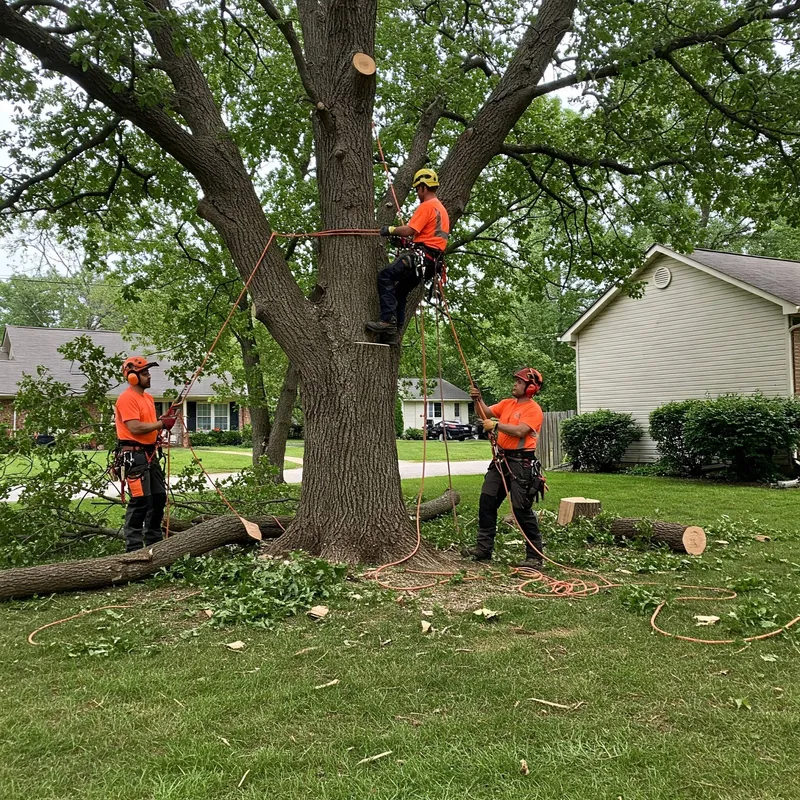
- Drop big limbs in three cuts. This is the "1-2-3" method: an undercut 12 to 18 inches out, a top cut just past it, then a final cut at the collar. It keeps the bark from tearing.
- Never top a tree. ISA says topping can strip 50% to 100% of the leaves, and the regrowth is weakly attached and breaks easily in wind and ice.
On big live oaks, raise only what you need for clearance, not every low limb. If a quote talks about "rounding over" a tree, get another quote.
What happens if you put off trimming?
Most of the trimming we do comes before something else gets built. Here is what we see when it waits:
- Dead limbs stay up there. ISA puts removing dead branches and reducing risk at the top of its reasons to prune.
- Limbs crowd new structures. Before we build a patio cover or deck, we look up. Limbs over the build area come up first.
- The yard below stays too dark. Thinning lets more light reach the ground, which helps new sod and planting beds under big trees.
- Lighting has to wait. If you want lights mounted in your oaks, it makes sense to prune and hang fixtures in the same safe window. Our landscape lighting cost guide explains why.
For oaks, miss the January 31 cutoff and anything that is not a safety issue waits until July.
How much does tree trimming cost in Austin?
It depends on the tree, how you get to it, and what sits under it. Tree work is slow, careful work at height, and cleanup is a big part of the job. These things move the price most:
- Size and how much comes off. Cleaning deadwood out of a 20-foot cedar elm is a different job than raising and thinning a 50-foot live oak.
- Access. Can a lift get in, or does the crew climb? Is the gate wide enough for a chipper?
- What is underneath. Over a roof, pool, or power line, limbs get roped down instead of dropped.
- Haul-off. Chipping and hauling everything costs more than leaving firewood stacked.
- Oak care and permits. Painting every oak cut adds a little time, and going past 25% on a regulated tree adds City review.
Trimming several trees in one visit usually costs less per tree than separate trips. Our tree trimming page lists the starting prices we work from. We price each job after we see the trees, and the estimate is free.
Should you hire a certified arborist or a landscape crew?
ISA says pruning above the ground or with power tools should be done by a professional arborist. ISA Certified Arborists have passed an exam and must keep taking classes to stay certified. You can check a credential with the free tool on TreesAreGood.org.
Ask these questions before anyone climbs your tree:
- Who will be in the tree, and is anyone on the crew ISA certified?
- Do you carry liability insurance, and can I see proof?
- Will you paint every oak cut, and do you prune oaks from February through June?
- How much of the canopy will you remove, in writing?
- What gets hauled away, and what stays?
We trim and remove trees as part of the yards we design and build. If an oak looks sick, have an arborist who knows oak wilt check it before anyone cuts.
Ready to get your trees trimmed before February?
Contact GardenGOAT with a few photos of your trees and what sits under them: the roof, driveway, patio, or power lines. We will walk the yard, tell you what should come down now and what can wait until July, and give you a free estimate. If a patio cover, lighting, or new beds are on your list, we can fold the trimming into one landscape design plan, so the trees are done before building starts.